
Jersey’s housing and population control regime plays a central role in regulating who can live and work in the Island and on what basis. The housing licensing rules affect a wide range of individuals and businesses, including new arrivals to Jersey, employers recruiting from outside the Island, and established residents seeking to move property or change employment status.
The rules are primarily designed to manage population levels while supporting economic growth, and they differentiate between individuals based on residential status, length of residence, employment role, and in certain cases, economic contribution. As a result, the application of the housing regime can be complex, with important practical and tax implications if not properly understood or navigated.
This briefing note has been prepared by the Grant Thornton Jersey tax team to provide a high‑level overview of Jersey’s housing licence framework. It explains the key categories of residential status, outlines when a housing licence may be required, and highlights common issues arising for employers and individuals. The note is intended as general guidance only and should be read alongside professional advice tailored to individual circumstances.
Why Jersey?
Jersey is an attractive and well‑established destination for individuals and families looking to relocate from the UK or further afield. As a self‑governing Crown Dependency with a long‑standing legal and regulatory framework, the Island offers political stability, fiscal independence and a reputation for sound financial management. Jersey has a robust reputation underpinned by its commitment to international standards on transparency, substance and information exchange.
Jersey operates a straightforward personal tax system with a standard income tax rate of 20% and no capital gains, inheritance or wealth taxes. This is supported by a respected legal system, high regulatory standards, and strong professional services infrastructure, including banking, funds, trust and fiduciary services.
Alongside its financial and professional strengths, Jersey is known for its excellent quality of life, offering a safe environment, good healthcare and education options, with easy access to the UK and Europe.
Overview of Control of Housing and Work statuses
Under Jersey’s Control of Housing and Work (Jersey) Law 2012, individuals are granted a “housing status”, which determines both their housing options and employment rights. The statuses form a graduated framework, with increasing levels of security and flexibility as individuals progress from Registered through to Entitled.
|
Status |
Who it applies to |
Housing rights |
Employment rights |
Key features / limitations |
|
Entitled |
Long‑term residents (10 years’ continuous residence) or individuals granted status on special grounds (e.g. High Value Residents). |
May buy, sell or lease any residential property. |
May work anywhere with no permission required. |
Highest level of status. |
|
Licensed |
Individuals regarded as essential employees, including senior inward investors, certain entrepreneurs, and owner managed businesses. |
May buy or lease qualified property (subject to licence conditions). |
Restricted to an approved employer and role. |
Status is conditional on continued employment. Loss of role usually results in loss of status. |
|
Licensed (Lease‑Only) |
Essential employees where buying rights cannot be justified. |
May lease only (cannot buy) Jersey property. |
Restricted to an approved employer and role. |
More limited form of Licensed status. Often time‑limited. |
|
Entitled for Work |
Individuals resident for 5 years, or qualifying through marriage. |
May lease registered (unqualified) property only. |
May work anywhere without permission. |
Mid‑level status offering employment freedom but restricted housing. |
|
Registered |
Individuals who do not qualify for any other status (default category). |
May lease registered (unqualified) property only. |
May only work for employers licensed to employ Registered staff. |
Lowest level of flexibility. Most restrictions on housing and employment. |
The system is designed to balance population control with economic need. Special regimes (such as Skilled High Earner, High Value Residence or Essentially Employed routes) effectively allow individuals to enter the system at a higher status than would otherwise be available based solely on length of residence.
Skilled High Earner
The Skilled High Earner (“SHE”) has recently been introduced in Jersey, and is designed for entrepreneurs or senior professionals who relocate to Jersey and establish an active business presence, generating sustained economic and social value.
Residential impact
- Applicants are granted Licensed residential status rather than Entitled status.
- Property acquisition or leasing is restricted to residential property valued at £2m or above.
- Licensed status is conditional and typically granted for up to 10 years or until Entitled status is achieved.
Tax impact
- Must demonstrate and maintain Jersey‑taxable earned income of at least £250,000 per annum.
- Subject to Jersey’s standard income tax regime (maximum rate of 20%), with no access to any preferential rates.
Lifestyle impact
- Requires genuine, ongoing business activity in Jersey for the duration of the licence.
- Residence and property rights are contingent on continued compliance with income and economic activity conditions.
- Provides a structured long‑term route to Entitled status after 10 years’ continuous residence.
Application insights
Eligibility requirements
- Applicant must not already be ordinarily resident in Jersey and must not hold existing residential status at the time of application.
- Commitment to establish a genuine business activity in Jersey, in any suitable legal form (company, partnership or sole trader).
- Requirement to work full‑time in Jersey (more than 25 hours per week) and to generate earned income from that activity.
Income and contribution requirements
- Ability to demonstrate Jersey‑taxable earned income of at least £250,000 per annum, sustainable for up to 10 years.
- Commitment to providing economic and/or social benefit to Jersey (for example mentoring, board roles, investment or charitable involvement).
Property requirements
- Whether purchasing or leasing residential property, it must be valued at £2 million or above.
Application process and evidence
- Detailed business plan and income projections.
- Personal CV, background information and financial evidence.
- Ongoing compliance monitoring throughout the licensed period.
High Value Residence
The High Value Residence (“HVR”) regime is intended for high‑net‑worth individuals (net wealth >£10m) whose residence can be demonstrated as delivering a clear and ongoing economic and/or social benefit to Jersey. Successful applicants are granted Entitled residential status immediately.
Residential impact
- Immediate Entitled status, providing unrestricted rights to buy, sell or lease “qualified” residential property.
- Applicants are required to purchase a high‑value property, generally valued at £3.5m+ for a house, or £1.75m+ for an apartment.
- No requirement for linked employment or business activity.
Tax impact
- Applicants must demonstrate sustainable worldwide income comfortably in excess of £1.25m per annum.
- A minimum annual Jersey income tax contribution of £250,000 index linked applies.
- Income tax is charged at 20% on the first £1.25m of worldwide income, with income above that taxed at 1%.
- Jersey levies no capital gains tax, inheritance tax or wealth taxes.
Lifestyle impact
- Maximum personal and professional flexibility, including the ability to work, invest, retire or manage global affairs without Jersey employment constraints.
- Unrestricted access to acquire a primary residence in Jersey (note: some restrictions still apply to acquiring additional property in Jersey).
- Heightened public, political and regulatory scrutiny given the exceptional nature of the regime.
Application insights
Eligibility requirements
- Generally sustainable worldwide income comfortably in excess of £1.25 million per annum, demonstrable over the medium to long term.
- Ability to make a minimum annual Jersey income tax contribution of £250,000.
- Evidence that the applicant’s residence will deliver economic and/or social benefit to Jersey (for example, business activity, philanthropy, community involvement or reputational benefit).
- Informal fiscal contribution expected to local Jersey charities or social causes.
Property requirements
- Ability to rent in Jersey for up to 1 year, restricted to properties with minimum rental value of:
- £100,000 per annum for a house; or
- £70,000 per annum for an apartment.
- Intention to acquire or lease a single high‑value residential property as the main residence, generally:
- £3.5 million or more for a house; or
- £1.75 million or more for an apartment.
Application process and evidence
- Detailed personal and financial disclosures, including global income and evidence of asset values.
- Narrative submission addressing the applicant’s background, motivations for relocation and anticipated contribution to the Island.
- Character and background checks.
Essentially Employed (Licensed) status
The Essentially Employed route is the traditional pathway for individuals filling roles considered essential to the Island’s economy. Residential rights are directly linked to a specific employer and role under the Control of Housing and Work Law.
Residential impact
- Licensed (or Licensed Lease‑Only) status granted in connection with an employer’s business licence.
- Ability to buy or lease qualified property depends on the specific licence conditions.
- A change in employer or role usually necessitates a new application.
Tax impact
- Subject to Jersey’s standard income tax regime, with a headline rate of 20%.
- No preferential rates or minimum contribution thresholds.
- Tax exposure is directly linked to employment income.
Lifestyle impact
- The least flexible route from a personal mobility perspective.
- Ongoing residence is dependent on continued employment.
- Housing and employment options are more constrained than under HVR or SHE routes.
Application insights
Eligibility requirements
- The individual must be filling a role that the employer can demonstrate is essential to the business and the Island’s economy.
- The employer must hold a valid business licence permitting the employment of Licensed (essential) employees.
- Residential status is tied directly to the specific employment role and employer.
Property requirements
- Depending on licence conditions, the employee may:
- buy or lease qualified residential property; or
- be restricted to leasing only.
- A change in role or employer usually requires a fresh application.
Tax considerations
- No minimum income thresholds or preferential tax regimes.
- Subject to Jersey’s standard income tax rules.
Application process and evidence
- Employer‑led application demonstrating skills scarcity and role necessity.
- Employment contract and role description.
- Ongoing monitoring while employment continues.
Side‑by‑side comparison
|
Key advantages |
Key disadvantages |
|
|
High Value Residence (HVR) |
Entitled status and full housing rights; Very favourable tax outcomes at high income levels; Complete independence from employers or business structures. |
High income generation requirements, minimum tax and property thresholds; Discretionary approval process; Increased scrutiny and expectations around economic and social contribution. |
|
Skilled High Earner (SHE) |
Lower barrier to entry than HVR; Suited to entrepreneurs and internationally mobile professionals; Clear pathway to Entitled status. |
Slightly restricted access to full property market; Ongoing income and activity review from Government; No additional tax incentives. |
|
Essentially Employed |
Lowest financial entry threshold; Well‑established and familiar regime; Appropriate where employment security is clear. |
Strong dependency on employer; Typically more limited housing and employment flexibility; No additional tax incentives. |
Note: Notwithstanding the above residential licencing options, any non‑British/Irish nationals may also require a separate immigration work permit alongside the licensed consent.
This article provides a high‑level overview only. It does not constitute legal, tax or immigration advice, nor does it consider individual circumstances or wider implications of relocation. Professional advice should always be obtained before making decisions.
Authors
-

Henry Armelin
Prior to joining Grant Thornton, Henry spent several years developing both his Jersey and UK tax knowledge with a Big 4 firm. He then moved to Revenue Jersey as a qualified tax professional where he played a key role in advancing their personal tax offerings, consulting on Jersey tax policy changes and leading Revenue Jersey’s High Value Residence services.View Profile
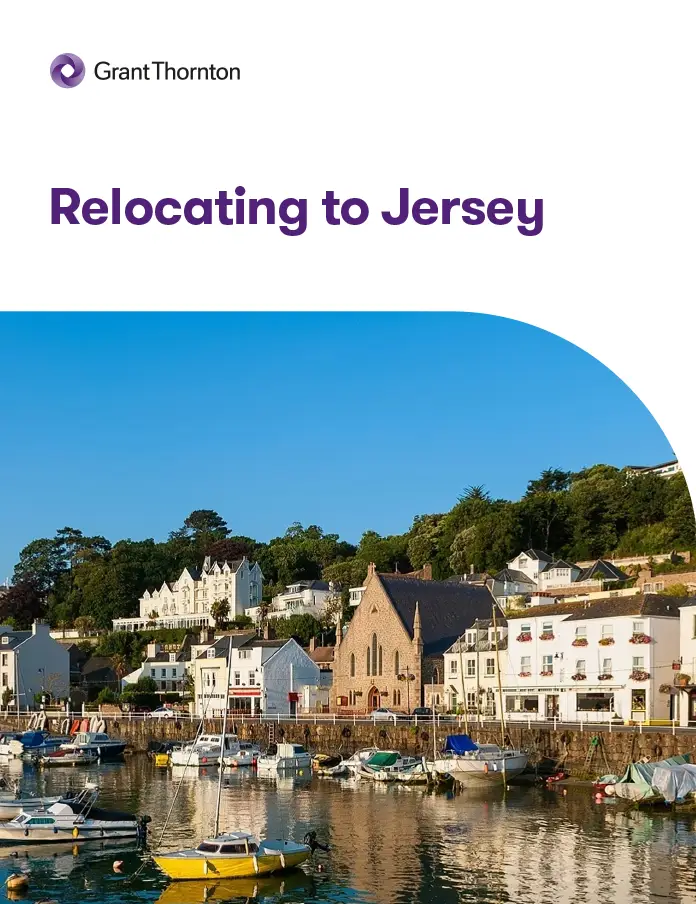
Relocating to Jersey
Jersey is an attractive and well‑established destination for individuals and families looking to relocate from the UK or further afield. As a self‑governing Crown Dependency with a long‑standing legal and regulatory framework, the Island offers political stability, fiscal independence and a reputation for sound financial management. Jersey has a robust reputation underpinned by its commitment to international standards on transparency, substance and information exchange.